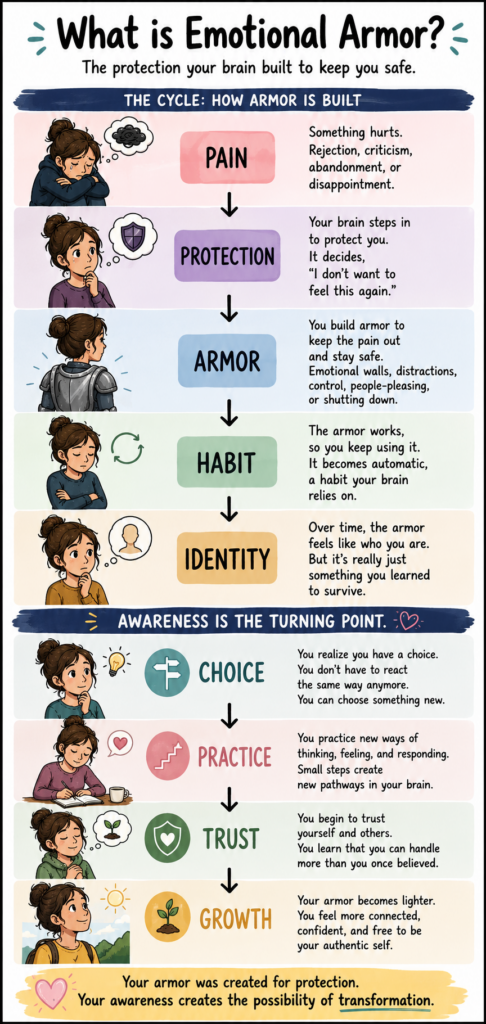
Your Armor
Understanding the Protection Your Brain Built
We all wear armor.
Some of us don’t even realize we’re wearing it.
It isn’t made of metal.
It’s made of thoughts, behaviors, and emotional patterns that helped us survive difficult experiences.
Your armor may have protected you from rejection, criticism, disappointment, conflict, or emotional pain.
It wasn’t created because something was wrong with you.
It was created because your brain learned that protection was necessary.
What Is Emotional Armor?
Emotional armor is made up of the protective strategies your brain developed over time.
It can look different for everyone.
Some people build walls.
Some become perfectionists.
Some make jokes to avoid vulnerability.
Some stay busy so they never have to sit with difficult emotions.
Some push people away before they can be hurt.
Others become people-pleasers because keeping everyone happy once felt like the safest option.
Over time, these behaviors stop feeling like choices.
They begin to feel like who we are.
But often, they’re simply the armor our brain learned to wear.
Why We Build Armor
Your brain has one primary job:
To protect you.
If you grew up believing that showing emotions wasn’t safe…
Your brain may have learned to hide them.
If you experienced rejection…
Your brain may have learned to expect it.
If you were criticized often…
Your brain may have learned to strive for perfection.
If trust was broken…
Your brain may have learned to keep people at a distance.
These weren’t conscious decisions.
They were adaptations.
Your brain was doing its best to help you survive.
When Armor Becomes Heavy
The challenge is that armor doesn’t always come off when the danger is gone.
The same protection that once helped you survive can begin to limit you.
It might keep you from:
Trusting people who genuinely care about you.
Expressing your emotions openly.
Asking for help when you need it.
Taking healthy risks.
Feeling truly connected.
Believing you’re enough without constantly proving yourself.
Armor protects us.
But it can also isolate us.
What Does Your Armor Look Like?
Everyone’s armor is different.
You might recognize yourself in some of these:
Always needing to stay in control.
Pretending everything is fine when it isn’t.
Avoiding vulnerability.
Keeping people at a distance.
Becoming defensive when receiving feedback.
Constantly people-pleasing.
Believing you have to handle everything on your own.
Expecting rejection before it happens.
Hiding behind humor.
Acting like you don’t care when you care deeply.
Becoming angry when you actually feel hurt.
Comparing yourself to others and feeling like you’re never enough.
Your armor isn’t your personality.
It’s protection.
You Don’t Have to Throw Your Armor Away
Healing isn’t about becoming completely unprotected.
It’s about recognizing when your armor is responding to today’s reality—and when it’s responding to yesterday’s pain.
As your brain begins to experience safety, trust, and compassion more consistently, it slowly learns that it doesn’t have to stay on high alert.
Over time, the armor becomes lighter.
Not because you forced it off.
But because your brain realized it wasn’t needed in every situation anymore.
Reflection
Take a few moments to consider these questions:
What does my armor look like?
When do I notice myself putting it on?
What might my brain be trying to protect me from?
Is my armor helping me in this moment, or is it keeping me from the life and relationships I want?
What is one small way I can safely lower my armor today?
Remember, the goal isn’t to judge yourself.
It’s to understand yourself.
What Helps the Armor Begin to Soften?
Your brain learns through repeated experiences of safety.
That might include:
Practicing supportive self-dialogue.
Learning to regulate difficult emotions.
Spending time with people who make you feel accepted.
Setting healthy boundaries.
Being honest about how you’re feeling.
Taking small risks that challenge old beliefs.
Treating yourself with the same compassion you would offer someone you love.
Each small experience teaches your brain something new:
“Maybe I don’t have to stay protected all the time.”
A Thought to Leave You With
Your armor is not your identity.
It is a protective strategy your brain learned through experience.
You don’t have to be ashamed that you needed it.
Healing isn’t about pretending it never existed.
It’s about discovering that you no longer have to wear it everywhere you go.